
St. Clair Projected Release Meanings
The St. Clair County Inmate Lookup can display a “Projected release” value in a current booking detail. The field is forward-looking, and observed records often show “N/A.” It is not the actual release record. Court action, bond processing, jail credits, holds, sentence computation, and transfer decisions can all affect what happens after the displayed estimate.
A pretrial detainee has no set release date merely because a case is pending. The person may leave after bond is posted and processed, after a judge changes custody, or after the case ends. Another hold can block the physical exit. For a sentenced county prisoner, the judgment, jail computation, credit for time served, discipline, and other holds shape the date. Ask the Sheriff for the actual timestamp after the event.
- Projected release
- A working future estimate that may change.
- Earliest Release Date
- The Michigan date when the Parole Board first obtains jurisdiction under the sentence.
- Date Paroled
- The MDOC date the person left prison or gained parole status in another supervised setting.
- Maximum Discharge
- The computed maximum end of the listed sentence, subject to the rules that apply.
Find St. Clair Projected Release Dates
Choose the record system by custodian. The county portal and court serve St. Clair jail cases. Michigan OTIS serves state prisoners and people under MDOC supervision. The BOP locator serves federal sentenced custody. A person missing from one system may be in another, and a departure from the county jail may be a transfer rather than release to the community.
- Search the official St. Clair County current-custody portal. Note the booking number, court, case number, charges, holds, refresh time, and any projected value.
- Open the 72nd District or 31st Circuit court case. Read the bond order, sentence, jail credit, commitment, and later orders.
- For a state prisoner, search Michigan OTIS by MDOC number or name. Read status, Assigned Location, Earliest Release Date, Maximum Discharge, and Date Paroled together.
- For a county sentence, call Jail Information at 810-987-1720 or request the maintained computation and release record from the Sheriff's Service Bureau.
- Follow any named detainer or transfer to MDOC, BOP, ICE, another county, or the U.S. Marshals Service. A local exit is not always the end of custody.
- After the event, confirm the actual release time with the releasing agency. Do not preserve an old projected value as if it were final.
The St. Clair County released-inmate lookup paths explain how the jail, court, state, and federal records fit together when the person is no longer on the live roster.
St. Clair MDOC Release Fields
Michigan OTIS is the right released-person system only when the case reached MDOC prison or felony supervision. It excludes county-jail-only and city-lockup sentences. OTIS covers current prisoners, parolees, probationers, and discharged people still within three years after supervision discharge. That public window is not a complete lifetime history.
The state's labels require care. Earliest Release Date, also called the Parole Board Jurisdiction Date, is when the applicable minimum has been reached and the Board can first consider parole. It does not book a ride through the prison gate. Maximum Discharge is the terminal sentence marker. Date Paroled and “Parolee” status are stronger evidence that prison release actually occurred.
| OTIS field | What it tells the reader | What it does not prove |
|---|---|---|
| Earliest Release Date | First Board-jurisdiction point under the sentence | A guaranteed or scheduled exit |
| Maximum Discharge | Computed maximum sentence end | That the person remains in prison until that day |
| Date Paroled | Date prison or camp was left, or parole status began in another setting | Completion of supervision |
| Assigned Location | Prison or supervision office shown by MDOC | The person's home address |
| Discharged | Listed MDOC jurisdiction ended | A complete history beyond OTIS retention |
The official About OTIS page defines the system's scope and date limits.
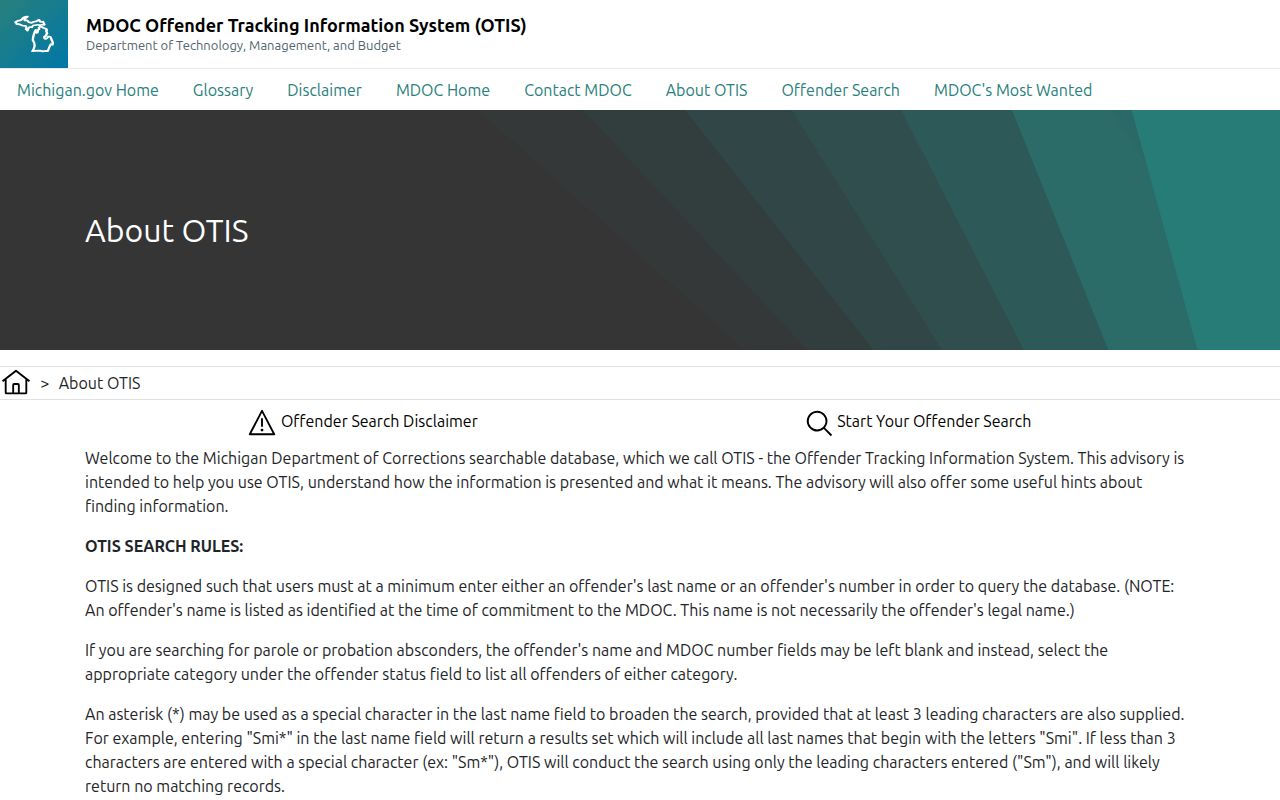
The captured page helps explain why an OTIS field must be read with status and why a county-jail-only case will not appear there.
Michigan Release Date Minimum Rules
Michigan does not apply the often-repeated 85-percent shortcut to modern covered MDOC minimum sentences. The MDOC truth-in-sentencing explanation says the full judicial minimum must be served before parole consideration for specified assaultive crimes committed on or after December 15, 1998, and all other crimes committed on or after December 15, 2000. For those covered cases, the rule is effectively 100 percent of the court-imposed minimum.
Good time and disciplinary credits do not shorten those covered minimums. Disciplinary time replaced sentence-reducing credits. Qualifying major misconduct creates disciplinary time the Board must consider, though MDOC says it is not simply added to the minimum as a fixed number of days. Older offenses may remain subject to legacy good-time or disciplinary-credit law, so the offense date and offense type matter.
MCL 791.233 sets the parole standard and minimum-service limit. MCL 791.234 addresses parole jurisdiction, older credit-eligible prisoners, disciplinary-time prisoners, consecutive sentences, and life categories. MCL 800.33 through 800.35 govern legacy credits and disciplinary time. None of these rules converts an Earliest Release Date into a promise of parole.
Note: The offense date, sentence structure, and MDOC classification determine which credit rules apply; a rough percentage is not a safe calculation.
St. Clair County Sentence Credits
A county jail term follows a separate statute. MCL 51.282 provides a qualifying county prisoner one day of reduction for each six days served without a rule violation. The reduction can be forfeited and restored. MCL 51.283 covers posted rules and the person's duty to call entitlement to the Sheriff's attention.
The statute alone cannot supply a final St. Clair County projected release date. The judgment, credit for time already served, jail calculation, disciplinary record, concurrent or consecutive sentence treatment, other holds, and later court orders all matter. No public St. Clair-specific calculator or weekend-release rule was verified. Do not substitute a web calculator or assume that a release will move to Friday when a computed date falls on a weekend.
Ask for the existing jail computation rather than asking the Service Bureau to create a legal opinion. Include the person's full name, date of birth if needed, booking number, case number, and sentencing date. Once the person leaves, ask separately for the actual release date and time, release authority, and destination if those fields are maintained and disclosable.
Why St. Clair Release Dates Move
Even a formally computed date may change because the legal record changes. A court can correct the judgment or add jail credit. MDOC can apply the correct treatment to multiple sentences. The Parole Board can grant, deny, defer, suspend, or rescind action. A new hold can redirect a person who otherwise completed the local term.
| Factor | Possible effect | Best confirmation |
|---|---|---|
| Court correction | Changes sentence terms or jail credit | Official judgment or amended order |
| Concurrent or consecutive terms | Changes how multiple sentences run | Court record and MDOC computation |
| Legacy credits | May reduce an eligible older sentence | MDOC record tied to offense date |
| Misconduct | Can cause forfeiture or affect Board action | Jail or MDOC sentence calculation |
| Parole decision | Grant starts processing; denial or deferral postpones release | Board action plus OTIS Date Paroled |
| Detainer or hold | Can lead to another custodian instead of community release | Release record and receiving agency |
A profile's Earliest Release Date is therefore a legal milestone, not a countdown clock. For a current St. Clair booking, “Projected release” can also be “N/A.” That value does not mean the person can never be released. It means the public detail does not supply a useful date at that snapshot.
St. Clair Parole Date Sequence
Michigan's Parole Release Unit takes over after a positive decision. It records the parole date, term, and special conditions, sends notices, and coordinates the approved placement. MDOC states that at least 28 days is required between the Board's decision and physical release. Favorable action can still be suspended if new adverse information or misconduct appears.
The sequence prevents a common error. Eligibility means the Board may consider release. A grant means release processing can advance. A scheduled date remains prospective. Date Paroled plus current “Parolee” status is the better public sign that the person left prison. Discharged status marks the later end of MDOC jurisdiction. These stages should never be collapsed into one “release date.”
The official parole consideration process documents that workflow.
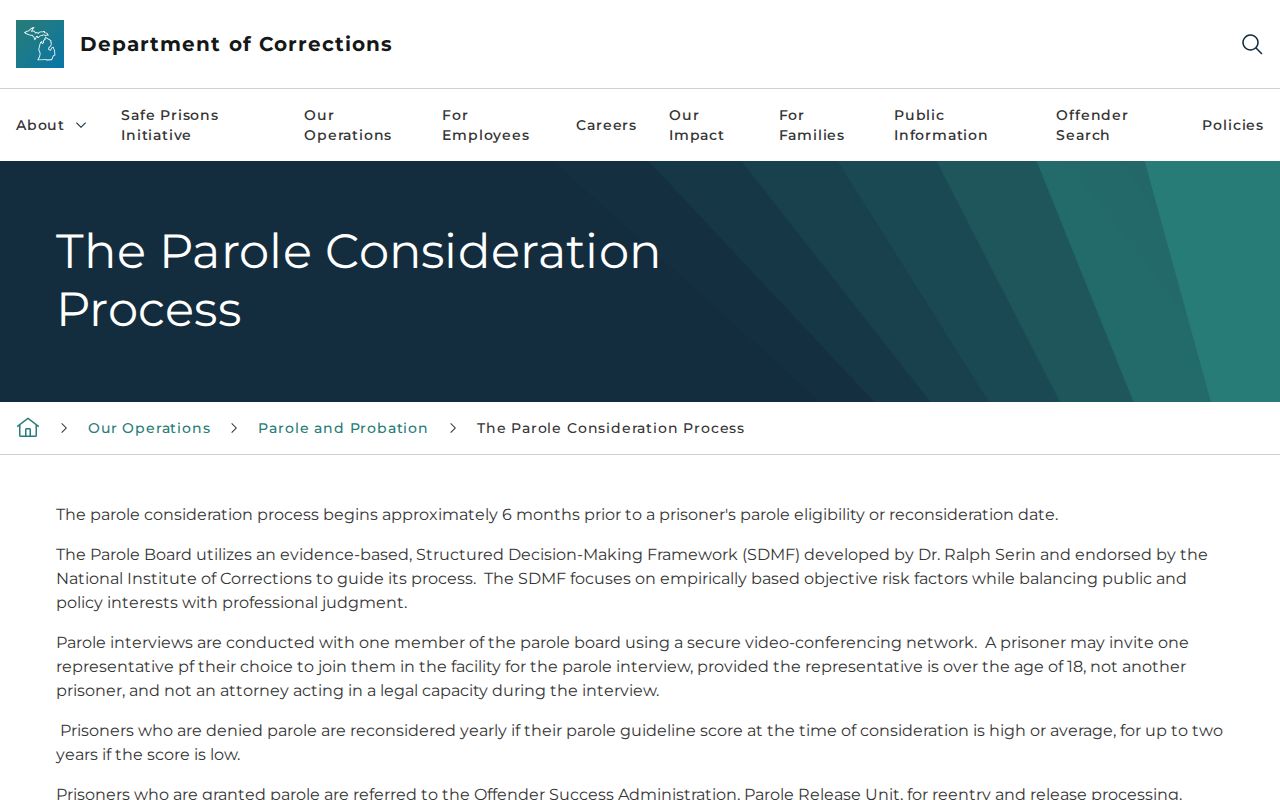
The captured process page reinforces that Board action and physical release are separate steps with time for release planning.
Confirm St. Clair Actual Release
Use MI-VINE before a pending county or state custody event when notification is available. A VINE alert reports that a participating agency sent a release, transfer, escape, or other custody event. It is useful, but it is not a certified historical record and it does not cover BOP, ICE, or the U.S. Marshals Service as Michigan county agencies.
After release, compare the alert with the custodian's record. For the St. Clair County Detention and Intervention Center, request the actual release timestamp, release authority or disposition, and receiving agency or destination if maintained. For MDOC, read Date Paroled or discharge information and request a discharge record when needed. For federal custody, use the BOP release date and location, then check whether another sovereign assumed custody.
The St. Clair County VINELink Inmate Search explains how to register for a specific person's event notice. Treat the notification as one part of a chain, not as a substitute for the jail, court, or corrections record.
Write down which agency supplied each date. A St. Clair jail timestamp, a court disposition date, an OTIS Date Paroled, and a BOP release date measure different custody events. They can all be accurate while showing different days. The safest final note identifies the custodian, field name, access date, and whether the value was projected or historical.
When a date conflicts, start with the underlying order and the agency that performed the computation. Court-derived errors may require a corrected order. A jail record question goes to the Sheriff's Service Bureau. An MDOC status or supervision issue goes to the department or assigned office. Ask for an existing record rather than a new calculation, and preserve the agency response with the case number.