
St. Clair County VINELink Coverage
MI-VINE means Victim Information and Notification Everyday. Michigan describes it as a free, confidential custody and court-status service available at all hours. Basic custody lookup and alerts are open to crime victims, families, and the public without a required victim relationship. For St. Clair County, its best role is prospective: locate a person while the participating jail still reports the record, then register for the next custody event.
County-jail notifications may include release, transfer, and escape. That difference among event types matters. A release event means the reporting jail changed the person’s status. A transfer event means control moved and prevents the false conclusion that the person became free from all custody. MI-VINE also offers general release notice for Michigan Department of Corrections prisoners, but state-prison notice is not identical to the county-jail event stream.
Telephone access is available at 800-770-7657 as an automated service. That channel matters when web access is unavailable, but it carries the same source limits as the online result. A caller should record the agency, exact event label, and event date, then ask the reporting custodian for the maintained release or transfer record. The phone message does not replace the Sheriff’s actual-release timestamp or an MDOC discharge record.
The official state overview is shown in this successful manifest image from the Michigan MI-VINE information page.
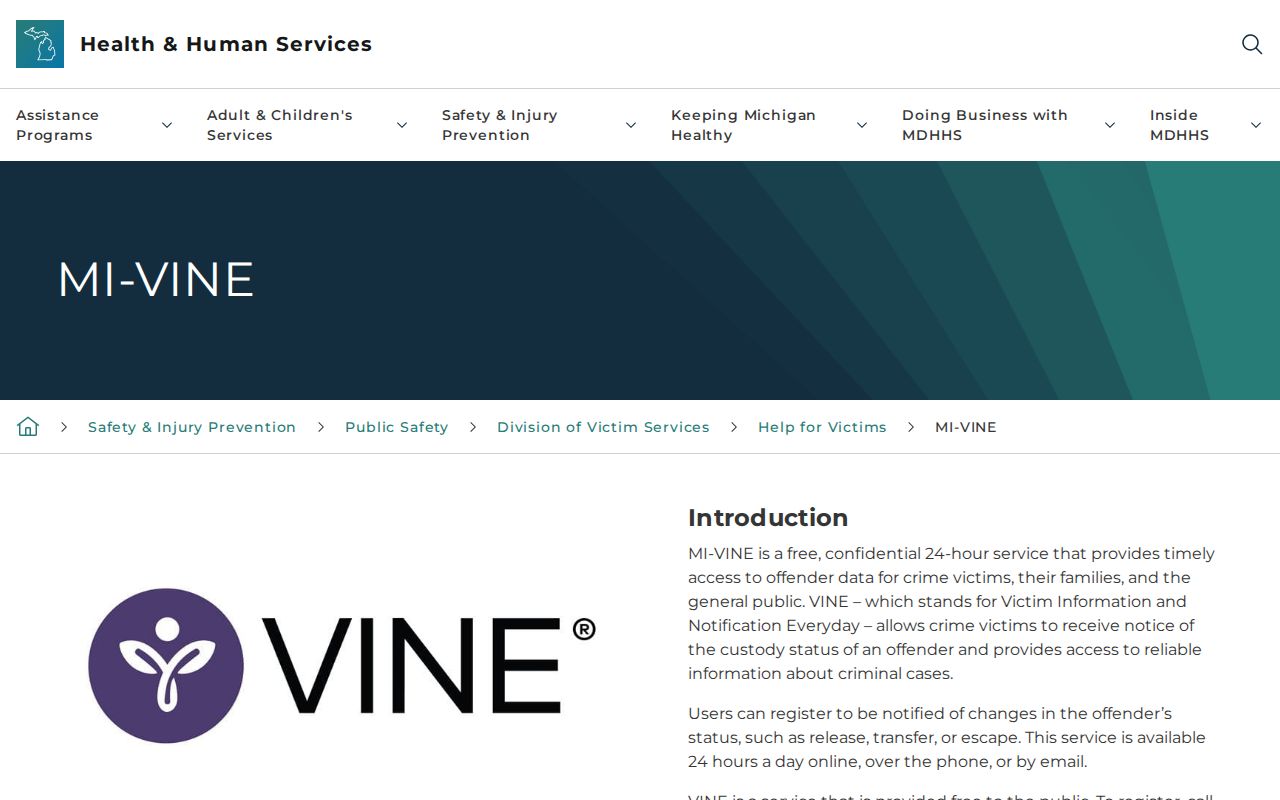
The overview establishes the state notification layer, while the Sheriff or MDOC record remains the better source for exact release documentation.
Search a St. Clair VINELink Record
Begin at the Michigan VINELink interface or open the national VINELink site and select Michigan. Search one person rather than treating the service as a recent-release feed. A known identifier is useful, but a name search can work when the identity is checked against the reporting agency, location, status date, and other displayed details. If the interface uses a precise status label, keep that wording instead of replacing it with a broader conclusion.
- Select Michigan and choose the available offender or custody search.
- Enter the person’s name or known identifier, then narrow by agency or displayed refiners when the option is offered.
- Open a possible match and compare identity details, reported custody status, agency, location, and status date.
- Resolve multiple matches with middle names, age or date of birth when shown, booking or offender identifiers, and the known custody timeline.
- Read “release,” “out of custody,” and “transfer” as separate reported events, then confirm the event through the agency that supplied it.
The current search interface can change its labels and screen order. The successful manifest capture comes from the VINELink Michigan one-person search.
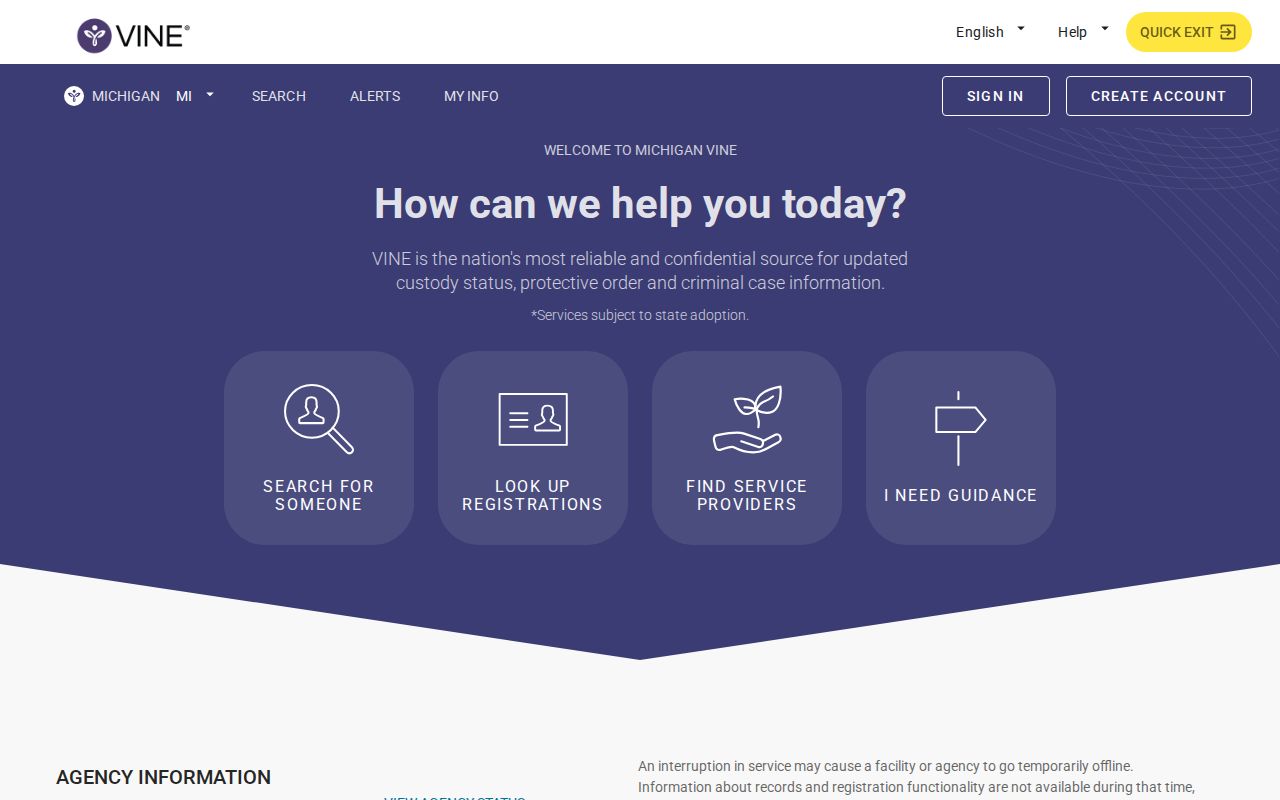
The image shows the correct Michigan route. Live controls and result labels should be read as they appear when the search is made.
Note: A name match needs an agency and identity check before its custody event is connected to the person sought.
St. Clair VINELink Release Fields
VINELink is an alert and status service, not a certified historical release record. Its displayed information is still useful when each field is read within that limit. The reporting agency identifies which custodian supplied the event. The status and date describe what that source reports. Location can point to current custody or the agency that last handled the record, depending on what the live result provides.
| Field | How to Read It |
|---|---|
| Name or offender identity | Begins the match but should be checked against identifiers and known facts. |
| Custody status | States the event or condition reported by the participating agency. |
| Reporting agency | Shows which jail or corrections source is responsible for the update. |
| Facility or location | Helps identify where custody is reported or which system should be checked next. |
| Status date | Places the reported change in time but is not always the full physical-release record. |
| Release event | Indicates the agency reported a release or out-of-custody change. |
| Transfer event | Warns that custody likely continued with another agency. |
| Notification options | Shows the phone, email, or text channels offered for that record or event. |
A released or out-of-custody result confirms an event from the reporting source. It does not prove that no other county, MDOC, BOP, ICE, or USMS authority holds the person. Likewise, a status date is not automatically the same as the time recorded on the St. Clair County jail release screen. Preserve both labels when they differ.
Register St. Clair Release Alerts
Registration starts from the matched person’s record. Choose the notification or “Get notified” function and select an available contact channel. The official MI-VINE instructions distinguish telephone registration, which uses a personal identification number, from email or text notice. Keep contact details current and make sure the record still points to the intended person and agency.
- Open the correct person’s live VINELink record and select the notification control.
- Choose phone, email, or text, then enter and confirm the requested destination.
- For a telephone registration, create a four-digit PIN when prompted.
- When an automated VINE call arrives, listen to the message and enter the PIN followed by the number sign.
- For email or text, follow the displayed confirmation process and keep the destination current.
- After an alert, verify the reported event with the Sheriff, MDOC, or receiving custodian.
Entering the telephone PIN confirms receipt and stops repeat calls for that event. Email and text do not use that PIN and provide one message for the change. The four-digit PIN should be easy for the registrant to recall but not shared as if it were an agency case number.
The national interface and its alert controls appear in the successful capture from the official VINELink site.
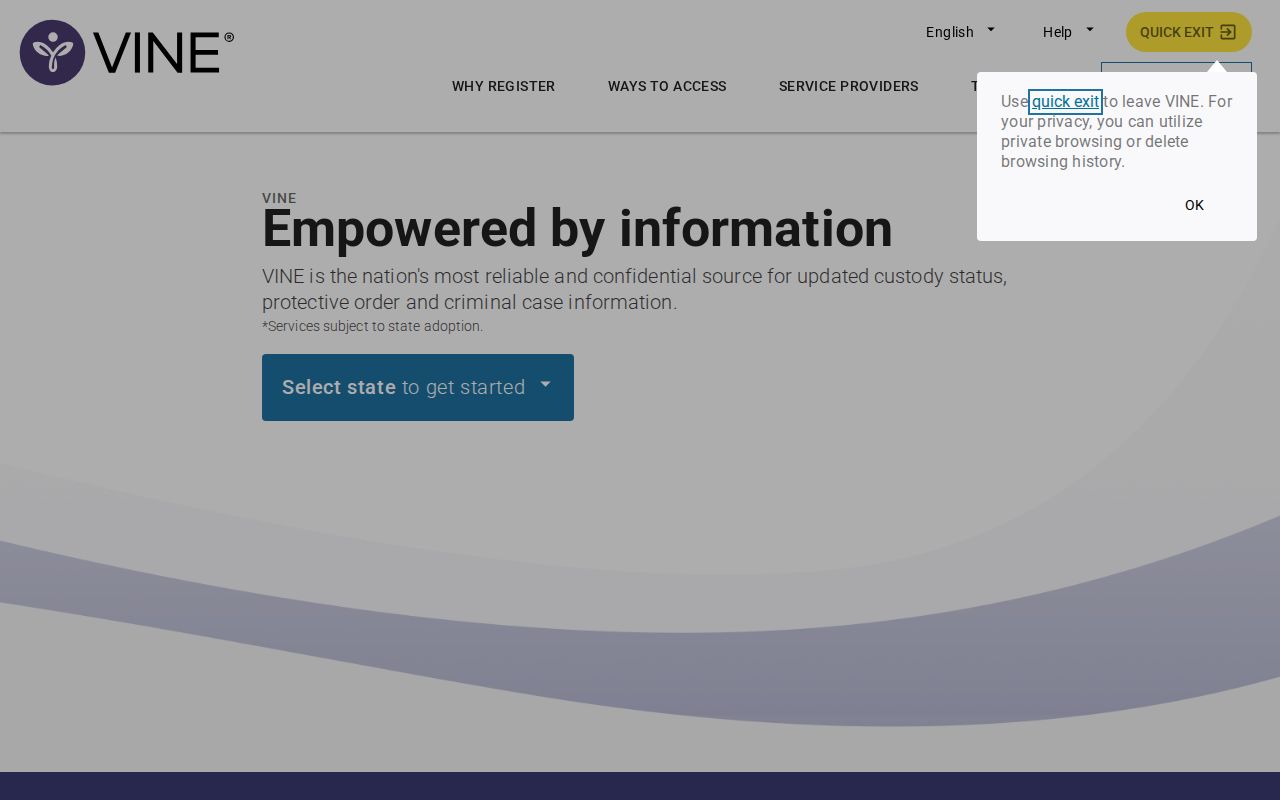
The live record determines which contact methods are offered, so the current screen should govern registration rather than an older screenshot.
St. Clair and MDOC Alerts Differ
Michigan’s notification structure has a local layer and a state corrections layer. For a person in the St. Clair County Detention and Intervention Center, MI-VINE can report participating county-jail custody changes such as release, transfer, or escape. For a person serving an MDOC prison sentence, VINELink offers a more general release notification. Direct victims who seek expanded MDOC notices, including certain parole information, use the MDOC Crime Victim Notification Unit at 877-886-5401.
That distinction avoids two common errors. First, a county release alert should not be presented as an MDOC discharge certificate. Second, an MDOC parole event means release from prison into supervision, not completion of the sentence. OTIS can show a parole status, Date Paroled, supervision location, Earliest Release Date, and Maximum Discharge information within its coverage. VINELink supplies notice; OTIS and MDOC records supply the corrections context.
A St. Clair County detainee transferred to state prison may stop appearing in the local portal before the MDOC record becomes the clearest source. The transfer alert is the bridge. Match the name, court, booking facts, and any new MDOC number rather than assuming the local release event ended all custody.
Note: “Paroled” means released from prison under MDOC supervision, while “discharged” means the listed MDOC jurisdiction has ended.
St. Clair VINELink Search Limits
VINE is automated. Data can lag, an agency can correct a record, and participation controls what is reported. It should not be the sole source for an urgent safety choice. A notice is also not a certified record. For the precise county-jail exit time, ask the St. Clair County Sheriff for the existing booking and release screen. For the legal case event, review the 72nd District or 31st Circuit Court record.
VINELink does not absorb federal systems into Michigan coverage. A person transferred to BOP, ICE, or the U.S. Marshals Service must be followed through the responsible federal route. The BOP Inmate Locator handles federal sentenced custody and post-1982 releases. ICE ODLS addresses current qualifying immigration detention, not a full historical release archive. USMS handles federal pretrial prisoner operations. A local VINE event cannot speak for all three.
Negative results need equal care. Not finding a person may reflect a different spelling, an agency that is not supplying the expected record, a custody move, or a system update. It does not prove that the person was never held or has been released. Try a known identifier, broaden the name, confirm the jurisdiction, and check the agency source.
The full named-person process on the St. Clair County released inmate search connects MI-VINE with the Sheriff record, county courts, OTIS, and federal locators. Use that broader chain when the reporting agency or next custodian is uncertain.
Confirm a St. Clair Release Event
After a VINELink alert, save the person’s displayed identity, event label, reporting agency, status date, and the time the alert arrived. Then contact the agency that supplied the event. For the St. Clair County Detention and Intervention Center, Jail Information is 810-987-1720. The facility is at 1170 Michigan Road, Port Huron, MI 48060, with a main number of 810-987-1700.
A records request should identify the person, booking number when known, and booking date range. Ask for the existing booking and release documentation, exact release timestamp, authority or disposition, and transfer destination when maintained and disclosable. That wording seeks an existing record. It does not ask the Sheriff to create a new opinion about what happened.
Compare the response with the court and follow-on custody record. A court order can authorize release before the physical exit. A VINE transfer can precede a new MDOC or federal result. Each date may be correct for its own event. Keeping the labels separate creates a reliable sequence without overstating what VINELink proves.
Note: Preserve the exact VINE event label, then use the originating agency’s record to document the custody change.